How you respond decides what a problem costs.
Speed matters, but it isn't the whole story. Research on waiting, apologies and acknowledgement shows how a well-handled request can win a guest back — and why a missed promise is worse than none.
is about how long US guests waited for a reply to a text before frustration set in.
ALICE, 2016 · hotel-software companyFixing a problem within 30 minutes, at a time agreed with the guest, had the strongest effect on satisfaction.
Jin, Purdue University, 2017well-handled problems left guests slightly happier than if nothing had gone wrong at all.
J.D. Power, 2010as many callers hung up when told their place in the queue — 35.9%, against 69.4% for those who heard music.
Munichor & Rafaeli, 2007
Waiting in silence is the problem
A personal reply with a realistic time makes the very same wait feel shorter.
A good response helps — but rarely erases the problem
The "service recovery paradox" says that fixing a problem well can leave a guest happier than before. It's a popular idea. The data tells a more modest story.
1A stay with no problems
760In J.D. Power's 2010 European study of 14,400+ guests, problem-free stays set the benchmark.
2A problem, reported and resolved
674Fixing it helped — a resolved problem scored better than an unresolved one. But most of the satisfaction lost to the problem stayed lost.
3A significant problem
651Without a good resolution, satisfaction fell 109 points below a problem-free stay.
The "better than before" effect shows up mainly when a problem is minor, happens for the first time and seems outside the hotel's control (Magnini et al., 2007).
Across studies, good recovery lifted satisfaction but not repeat visits or word of mouth (de Matos, Henrique & Rossi, 2007). Prevention still wins.
What the guest feels while waiting
"Thanks for your message!" arrives instantly — then nothing. Twenty minutes later the guest has no idea whether anyone is coming. Research rates an automatic reply no better than no reply at all.
"Hi, it's Thandi from housekeeping — fresh towels in about 10 minutes." The guest knows who, what and when. The wait is the same; the experience isn't.
An apology beats compensation
Compensation didn't make up for a slow recovery unless it came with an apology (Wirtz & Mattila, 2004). Guests want to be heard before they're handed anything.
Why acknowledgement matters as much as speed
Delays hurt mainly by creating uncertainty and anger (Taylor, 1994). Unexplained waits feel longer than explained ones (Maister), and telling people how long they'll wait stops them overestimating it (Hui & Tse, 1996).
Promising a time and missing it left customers less satisfied than making no promise at all (Kumar, Kalwani & Dada, 1997). Quote conservatively.
A sense of progress changes the whole wait — the same reason callers told their place in the queue hang up half as often.
Of 18 studies on complaint response speed, 9 found a clear positive effect, 3 found none and 6 were mixed (Davidow, 2003). Speed helps — but it isn't the only lever.
A response routine that matches the research
For serious problems, a prompt response does the most good; for minor ones, a gesture can matter more (Liu et al., 2019). Either way the order is the same: acknowledge, apologise, give a realistic time, fix, follow up.
- • Generic automatic replies
- • Optimistic time estimates
- • Leading with a freebie instead of sorry
- • Going quiet when a fix runs late
- • Acknowledge personally within minutes
- • Say who's handling it and roughly when
- • Aim to resolve within 30 minutes
- • Update the guest before a promised time runs out
of Hilton guests who used in-stay messaging in 2023 said it improved their stay (Hilton brand data, 2024).

J.D. Power found the ideal check-in takes five minutes or less; missing speed, accuracy or a warm welcome cost up to 100 points (2019).
What the research doesn't say
Where the evidence is weaker than a catchy headline would suggest.
Speed doesn't cancel a problem
On average, even a fast resolution recovers only part of the satisfaction lost.
The 12 minutes is one survey
It comes from a 2016 survey of US travellers by ALICE, a hotel-operations software company.
The review link is inferred
No independent study links faster in-stay request handling directly to higher review scores; the link comes from complaint, waiting and recovery research.
Replying to reviews is different
For responses to online reviews, one study found empathy mattered and speed didn't.
The paradox is unreliable
A survey of more than 11,000 bank customers found the "better than before" effect rare.
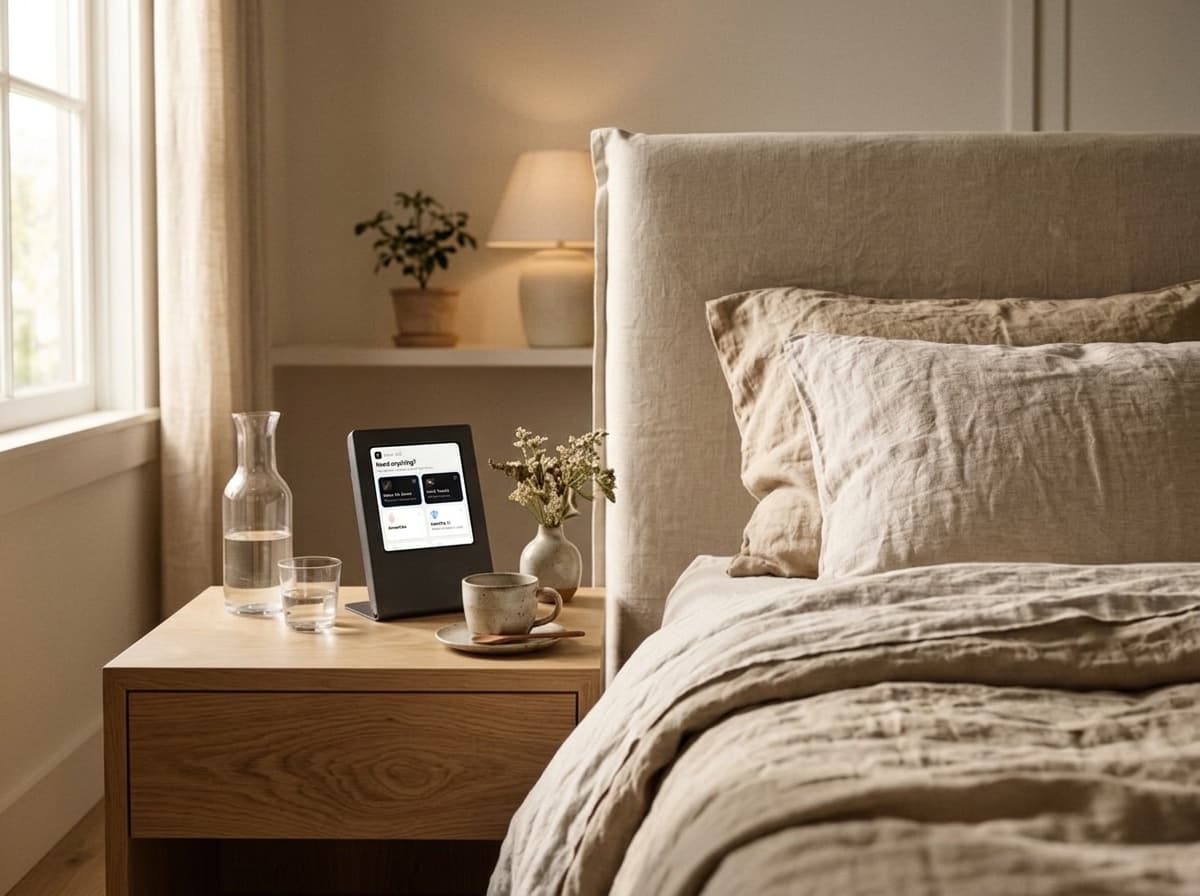
How RoomCheck helps
The research supports three things: speed, a visible sense of progress, and nothing forgotten. The apology, the realistic time and the warmth still come from your team.
RoomCheck takes care of the mechanics. A guest's request is acknowledged on the device straight away, it reaches the right person on WhatsApp, and its status is tracked until it's done — with an escalation if it runs long — so no request waits in silence.
- Instant acknowledgement on the device
- Routed to the right staff member
- Tracked to completion, escalated if late
Industry research sources
J.D. Power studies
• J.D. Power (2010). European hotel guest satisfaction study: problems and resolution.
• J.D. Power (2019). Quality of sleep is a significant opportunity for North American hotels.
• J.D. Power (2026). North America Hotel Guest Satisfaction Index Study.
Academic research
• Jin, Purdue University (2017). Hotel service recovery timing (master's thesis).
• Magnini et al. (2007). When the service recovery paradox appears.
• de Matos, Henrique & Rossi (2007). Service recovery paradox: a meta-analysis.
• Mattila & Mount (2003). The impact of customer characteristics and response time on e-complaint satisfaction.
• Liu et al. (2019). Examining the trade-off between compensation and promptness.
• Wirtz & Mattila (2004). Recovery speed, apology and compensation.
• Istanbulluoglu (2017). Complaint handling on social media.
• Davidow (2003). Review of complaint response research, Journal of Service Research.
• Maister (1985). The Psychology of Waiting Lines.
• Taylor (1994). Waiting for service, Journal of Marketing.
• Munichor & Rafaeli (2007). Telephone waiting: queue information vs music and apologies.
• Hui & Tse (1996). Waiting-time information and service evaluation.
• Antonides et al. (2002). Consumer perception and evaluation of waiting time.
• Mattila et al. (2013). Automatic vs personal replies to complaints.
• Kumar, Kalwani & Dada (1997). The impact of waiting-time guarantees on customers.
• Min, Lim & Magnini (2015). Empathy and speed in replies to online reviews.
• Michel & Meuter (2008). The service recovery paradox: true but overrated?.
Industry & vendor data
• ALICE, via Skift (2016). Hotels find that guests won't wait when it comes to mobile messaging.
• ALICE (2019). Most hotel guests rank unfriendly staff as most frustrating.
• HubSpot Research (n.d.). Live chat expectations (not hotel-specific).
• Revinate (2026). Hospitality messaging report, North America.
• Hilton (2024). Hilton expands on-property messaging.
More from the research series
The button you never press: why feeling able to ask matters
Why knowing you can ask makes guests feel better, the effort barrier behind silent complaints, and how guests prefer to reach you.
The second failure: why an unresolved problem hurts more than the problem itself
11%, 20% or 26%: how your response decides what a problem costs, and why a broken promise hurts more than the broken shower.

Your score is your shop window: how review scores drive revenue
What 0.3 points is worth to a 10-room guesthouse, how booking sites rank you, and why independents gain most from great reviews.
Ready to catch guest friction before it hits Booking.com?
Put a discreet RoomCheck device in every room. Keep communication warm, housekeeping accountable, and reviews immaculate.
- No long-term lock-ins
- 1-minute room setup
- One device per room
- Trusted by 500+ rooms live